


“Let me first go and bury my father.” This request from a would-be disciple, and Jesus’ startling reply—”Follow me, and let the dead bury their own dead”—has troubled readers for two millennia. It seems to pit the urgency of discipleship against the foundational commandment to honor one’s parents. However, insights from first-century Jewish burial practices reveal that the man’s request was likely not about an imminent funeral but about a far-removed, future family obligation. Understanding this cultural context shows Jesus not as dismissive of filial duty but as challenging a delay that would subordinate the transformative, immediate call of God’s kingdom to a manageable, later convenience.
The Biblical Context
In Matthew 8:18-22, amid displays of Jesus’ authority—healing the sick, calming the storm, and casting out demons—two potential followers approach Him. A scribe pledges enthusiastic loyalty, only to hear Jesus warn of the cost: “The Son of Man has nowhere to lay his head.” Then another says, “Lord, permit me first to go and bury my father.” Jesus responds sharply: “Follow me, and let the dead bury their own dead.”
Luke 9:57-62 records a similar exchange during Jesus’ journey to Jerusalem, adding a third person who wants to say goodbye to family. Jesus replies, “No one who puts a hand to the plow and looks back is fit for the kingdom of God.”
Both Gospels portray discipleship as demanding absolute priority over security, family obligations, and social norms. Matthew highlights the cost amid Jesus’ miracles; Luke stresses forward commitment on the road to the cross.
Key Passages
Now that we have seen the context, let us zoom in on our texts.
21 And another of the disciples said to Him, “Lord, allow me first to go and bury my father.” 22 But Jesus said to him, “Follow Me, and let the dead bury their own dead.” (Mat 8:21-22)
59 And He said to another, “Follow Me.” But he said, “Lord, permit me first to go and bury my father.” 60 But He said to him, “Allow the dead to bury their own dead; but as for you, go and proclaim everywhere the kingdom of God.” (Luke 9:59-60)
The texts are somewhat different, but they essentially convey the same message in slightly varied versions. The difficulty arises from Jesus’ seeming disregard for one of the ten commandments.
Honor your father and your mother, so that you may live long in the land the Lord your God is giving you.” (Ex 20:12; Deut 5:16)
Attending one’s father’s funeral and bidding farewell to the man who played an instrumental role in one’s birth and upbringing seems an obvious expression of honoring him.
This concern is deepened by Jewish traditions in the Second Temple period, where proper burial of the dead was regarded as a profound act of piety and charity. For example, the Wisdom of Ben Sira (Sirach, composed ca. 180 BCE) stresses honoring parents, including care in old age and proper remembrance after death (Sirach 3:1–16; 7:27–28). In the Book of Tobit (a text widely revered in Second Temple Judaism, composed around 200 BCE), Tobit repeatedly risks his life to bury fellow Jews left unburied, viewing it as one of his chief righteous deeds (Tobit 1:16–20; 2:3–8).
Similarly, the historian Josephus (writing in the late first century CE) notes that even Jewish passersby were expected to join funeral processions in lamentation (Against Apion 2.205). In later rabbinic sources, reflecting traditions that extend back to this era but were codified later, further underscore burial as a supreme mitzvah of kindness, with the duty falling especially on sons (Mishnah Sanhedrin 6:5).
Various Interpretations
Historically, Christian interpreters, including Church Fathers like John Chrysostom and Augustine, understood Jesus’ words—”Follow me, and let the dead bury their own dead” (Matthew 8:21-22; Luke 9:59-60)—as a metaphorical call to prioritize the kingdom of God radically over even sacred earthly duties.
They viewed the “dead” as the spiritually dead (unbelievers or those indifferent to God’s call) who can handle physical burials. This emphasized immediate allegiance to Christ, often seeing the request as an excuse for delay.
Modern scholarly consensus largely favors an idiomatic reading: “bury my father” meant waiting until the (living) father’s death and fulfilling family/inheritance obligations—potentially years away—thus exposing procrastination.
A Key Insight from Archaeology: Secondary Burial
Recent archaeological insights into first-century Jewish burial customs offer a clarifying, and perhaps more responsible, solution to this dilemma.
The key idea that provides an insightful perspective on the text is that Jews at the time of Jesus did not bury their dead once, but twice. We are already familiar with the primary burial (think of Lazarus or Jesus Himself, both placed in a tomb cave). This is what is described in John’s Gospel:
39 Nicodemus, who had first come to Him by night, also came, bringing a mixture of myrrh and aloes, about a hundred litras weight. 40 So they took the body of Jesus and bound it in linen wrappings with the spices, as is the burial custom of the Judeans/Jews. (John 19:39-40)
Archaeology provides overwhelming evidence that there was also a secondary burial. This rite, known as ossilegium, was not exclusively Jewish but was the preferred practice among Jews for centuries before and after the time of Jesus. This was especially true in Judea, though the practice was also known in more remote places like Galilee.
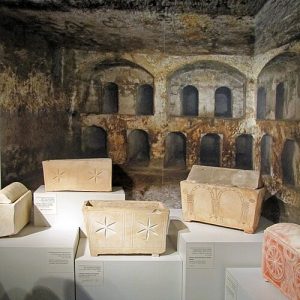
The body, wrapped in burial cloths, was left in the tomb cave for an extended period (often about a year) to decompose. Then, someone knowledgeable in Jewish burial practices would enter, inspect the remains, and—once mostly bones remained—collect them, place them in an ossuary (a limestone bone box), and store the box in a niche or separate chamber within the family tomb.
While the son would certainly be present or involved in arranging this process as an act of filial piety, he himself would be unlikely to personally handle his father’s bones. Someone else from the community typically performed that hands-on task.
One of the “small tractates” (masechtot qetanot) appended to editions of the Babylonian Talmud is Tractate Semahot, a minor tractate in rabbinic literature. It is the classic and oldest comprehensive rabbinic text dedicated to laws and customs related to death, burial, mourning, and funeral rites.
Rabbi Eleazar bar Zadok said, “Thus spoke my father at the point of death: ‘My son, bury me at first in a fosse [ditch/trench]. In the course of time, collect my bones and put them in an ossuary, but do not gather them with your own hands.’” (Tractate Semahot (Evel Rabbati) 12:9)
Therefore, if this reading is correct, the would-be disciple with whom Jesus spoke was likely a man whose father had died some time ago—but whose secondary burial (ossilegium) had not yet taken place. The man was asking to delay following Jesus until this final rite was completed. He used it as an excuse, explaining why radical obedience to Christ’s call and proclamation of the Kingdom of God’s arrival simply came at a poor time in his life.
But what about Jesus’ enigmatic reply, “Let the dead bury their own dead”?
Within the context of first-century Jewish secondary burial practices, this phrase carries profound irony and fits the cultural reality perfectly.
One plausible explanation lies in the ritual impurity involved: those knowledgeable handlers who entered the tomb to collect and transfer bones (often community members rather than the son himself) would contract temporary defilement from contact with the dead (Num 19:11, 14–16). In Greek, νεκρούς could evoke those temporarily “dead” in a ritual sense—defiled and set apart—while performing duties related to the actual dead. The shift from Jesus’ spoken Aramaic (or Hebrew) to the Gospels’ Greek may have amplified this layered meaning for later readers distant from the customs.
A more striking and widely noted possibility is Jesus’ use of sharp, playful irony to expose the man’s procrastination. The would-be disciple claims urgency—“Let me first go and bury my father”—yet the secondary burial (ossilegium) would not occur for months, after full decomposition. Family tombs typically held multiple bodies at various stages: some freshly laid, still fleshing out; others already reduced to bones in ossuaries or niches.
Jesus retorts, in effect: “Let the dead (the dry bones of prior deceased already in the tomb) ‘bury’ their own dead (handle the remains of those still decomposing, like your father). You’ve already fulfilled the primary burial—stop delaying with this future obligation and follow me now.”
This interpretation underscores the absurdity: literal corpses are incapable of burying anyone, thereby highlighting the insignificance of such excuses in comparison to the Kingdom’s urgent demands. As seen in archaeological evidence from Jerusalem-area tombs and echoed in sources like Tractate Semahot, multiple generations shared these caves, making Jesus’ wordplay culturally resonant and pointed.
While the secondary burial explanation fits archaeological evidence compellingly, many scholars see ‘bury my father’ as an idiom for awaiting a living father’s death, making the request a long-term delay. It is important to remember that primary burial was immediate (same day/next), so if the father had just died, the man wouldn’t be approaching Jesus so casually in conversation. This observation supports either that the father did not yet die at all (majority of modern scholarship) or that secondary burial is in view (minority of modern scholarship).
Conclusion
Multiple interpretations help resolve the apparent conflict with the clear commandment to honor one’s parent, affirm the urgency of Jesus’ call, and one even fits well with first-century Jewish customs uncovered by archaeology. It shows Jesus not as unreasonable, harsh, or dismissive of family duties, but as one who fully understood the cultural context and appropriately challenged the man to align his actions with his words.
When viewed through the lens of first-century Jewish practice, the well-known exchange changes from a confusing moral conflict to a deep revelation of God’s priority. The man’s request was not about immediate grief but about postponing discipleship for a year or more—until the secondary burial rite was complete. Jesus’ reply, therefore, is not a dismissal of filial duty but a radical re-centering of allegiance in light of the inbreaking Kingdom.
His words cut to the heart of every disciple’s temptation: the desire to place God’s call on our own timeline, to subordinate the urgent work of the Spirit to the manageable rhythm of inherited obligations. Jesus exposes this not as piety, but as procrastination—a form of spiritual death.
Today, Christ’s call retains its unrelenting urgency. The “secondary burials” we plead—finishing this project, reaching that milestone, waiting for a more convenient season—are often just respectable excuses. The Kingdom will not wait for our calendars to clear. The King demands that we rearrange our schedule for Him.


Thanks. That was interesting and well explained as always. I love the way you explain. It adds deep meaning.
My personal feeling of this verse is that we must follow Jesus as He has a living Father and He gives eternal life. Following Jesus is going towards life but burying the dead does not even if it honors the parent. I do not believe Jesus would be disrespectful of burial laws but rather intended the man to seek Him and life and leave legalism behind.
Thank you so much, Sharon!
I have spiritual perspective on this.
For in spirit we are alive in Yeshua, yet in our natural state we are spiritually dead. The cal of Yeshua to follow him means that we become spiritually alive. Spiritual death is when we are not in Him and He in us we have no spiritual connection.
Let they who call on Yeshua be spiritually alive. They who reject Him are spiritually dead.
For He is the Light of this world
Terrence, thank you for your comment.
Thank you for illuminating this challenging passage. Understanding burial practices certainly makes the words of Jesus more convicting. How often do we postpone answering the call of the LORD for a more convenient time?
Indeed, thank you, Patricia!
Dear Dr Eli, it’s such a blessing reading your posts. Thank you so much and may God bless you for the way you widen our perspectives and understanding of our Lord’s words.
Thank you for your support and encouragement!!!
Amen. Praise the Lord
Blessings!
A poor excuse, for the dead were buried the same day of death and no one would be following a teacher that day.
Spiritually dead, bury the physically dead.
Ephesians 2:1 And you hath he quickened, who were dead in trespasses and sins.
1 Timothy 5:6 But she that liveth in pleasure is dead while she liveth.
Spiritually dead, bury the physically dead, Jesus knew that if he returned home, he would likely submit to the unbelieving relatives who would weep, reproach, ridicule, and tempt him to give up such an idea.
Thank you for your comment
[ 22 Related passages about the spiritually dead who do not have eternal life: Luke 15:24,32 & John 5:24 & Rom. 4:17 and 5:14-17 & Eph. 2:1,5 & Col. 2:13 & 1 Tim. 5:6]
Thanks for your comment.
Hi there.
How to assign to the histórical site: Root branch association Ltd.
Shalom.
I am not sure what do you mean?
Thank you for sharing the cultural and spiritual practices of the times recorded in the scriptures.
Having comprehension of the practices of the times written about that are not known in the present-day context provides keys to deeper comprehension.
As an aside, if the young man’s father was deceased at that time, would he have been part of the resurrected lives recorded to have been witnessed?
Val, I got everything but your final question/point. Please restate.
Always great insights on often misunderstood readings. We living in the 21st Century clearly can not understand the words of Yeshua without a knowledge of the time in winch he lived. Thanks for clairfication on so many of the misunderstood passages of Scripture!
Thanks, Barbara! Yes, it takes effort for us to bridge that gap.
Thank you for providing this much needed context. It makes the text more understandable.
Excellent!
Thank you Rabbi Eli for bringing clarity to a subject that has troubled me for a number of years. Makes perfect sense now!
Blessings to You,
Dori
Dori, I am not a Rabbi (in a sense of ordained rabbinical figure) just wanted to be clear about it. But I know that you mean a title of high respect, so I humbly accept this great honor. May the Lord, who is our ultimate Rabbi and Lord, give us His light!
Thank you Dr. Eli for all your insides charing this with us. Opeing my eyes to see more and more from Jesus.
Amen, Bart! I am so grateful for your feedback! Let us grow together! We’ve come to see Jesus and him only.
Thank you DR. Eli for clarifying my call, and recognizing my respect for you! May Yeshua truly bless you!
In His Name, Dori
Amen!
The study of God’s Word should be seen in the customs and times of the time it was written. Not of today’s present customs.
indeed!
There seems to be a similarity in calling found in Luke 9:61 and 1 Kings 19:20 in Elisha’s calling, the main difference is Elisha is allowed to go back briefly whereas in Luke the following of Jesus is imminent.
Thanks for your comment!
This appears to be a good analysis of theee challenging passages. Thanks
Indeed it so appears 🙂
A question abouth death: Harrowing of Hell how can it be interpreted in ancient jewish contesto?
Not sure what you mean.
Im blessed….Godbless you too… Amen
Thank you!
Thank you, Dr. Eli, for the exegesis. It is pretty enlightening and has given me new insight into understanding the passage in question. However, I understand the knotty part of the passage in the light of John 10:10 and would interpret it from the angle of those in Christ having life and those who are not as being spiritually dead.
Again, I find the interpretation of the dead bones in the tomb burying their own dead confusing. You may want to throw some light on that if possible.
Thank you for the beautiful job you are doing!
Fr. Michael, thank you for your comment. I agree it is the weaker part of the article.
Let the dead in Christ bury the dead in Christ, follow me and live. You are dead in the law, but alive in Christ. If you cannot explain it simply, you just dont know it well enough. Albert Einstien
You might be interested in three of the Old Testament novels I have published. Gideon: The Sound and The Glory, David God’s Chosen Crucible, and Second David: Trials and Tribulations. On Amazon, as a writer friend, the Titanic always sinks, meaning I dont change outcomes and keep it true to the scriptures. In other words, insights, not biblical rewrites. Amazon, where else?
Thank you and God bless.
Dr. Eli, SO GOOD. Thank you. Interestingly, we worked among a people group that practice something like ossilegium. Even the part where many bodies may be in the same tomb/cave. I personally observed the practice of transferring bones to the “box”. It was a profound experience. In this case, it happened when another family member died; the body of the recently dead person was laid in the tomb (above ground), and the bones of earlier family members were collected and moved to a box in the tomb. Your exegesis is excellent and makes really good sense of the passage. Thanks so much for your excellent research. A great help to assisting us in understanding these difficult (and also less difficult!) passages.
Thank you, my brother! Would it be possible to say where this was observed? May the Lord bless you and keep you!
Dr Eli, you have such a way of communicating the truths of the Holy scriptures, leaving no stone un-turned. Thank you
I am so blessed. Thank you so much!
Shalom
Dear Dr. Eli this reminds me of 1 Samuel 2:29 backwards. 👍🏼
Thanks for your comment.
Shalom Dr Eli! Thank you for a well researched and well argued point of view using the secondary burial perspective.
Your whole argument of course is originally is based on Jesus upholding the 5th commandment.
A possible alternative interpretation is that Jesus considered our obligations to our parents to be mandatory only while they are alive. Hence ‘let the dead bury the dead’.
Those who are alive are free of that obligation in the light of the higher call to follow Him.
This would mean of course that Jesus was calling the man into radical discipleship at a time of great grief.
Your thoughts?
Shalom, Constantine. Good to hear from you! It is very hard for me to think about Jesus thinking that the burial of one’s parent is not part of that honoring.
I think at the father’s death the will would be enacted. To not wait until the father died would be to sacrifice his portion of the will. It’s a count the cause situation in play here
Waiting to see how well dad’s stocks might benefit you after he dies is almost tantamount to dishonoring one’s parent. What have you done for me lately. Waiting for you to die ( don’t put it off to long ) I want what’s coming to me
Not sure that Jesus was so concerned about the burial traditions or details as interesting as they were. Probably they were both aware of them. Thinking Jesus was more concerned about the man’s values which determined his priorities. Counting the cost is usually an either, or
Thanks for your comment.
Shalom! Dr Eli . It’s good to read your insight. Doing well the scriptures, making it to understand Jewish way. Forbid me! for the advice, why don’t you consider writing on Christian foundational and building words of NEW Testament covenant relationships ? May GOD bless you.
Dear Dr. Manmohansingh Nety, shalom! Thank you for your encouragement and support! Do you mean words like “covenant” and “righteousness,” or do you have something else in mind? Thank you so much for the suggestion! (I am ESPECIALLY interested in particular difficult texts (more than single words)).
Dr. Eli
Thank you, thank you, thank you for clarification!!! For years this scripture has left me me confused 🤔. God bless 🙏 you.
So happy to hear! You are not alone!
Thank you Dr Eli for such thorough explanation in this article. It also brings about the urgency of Yeshua’s words:” Repent, the Kingdom of Heaven is at hand”. Complacency can lead someone to go astray. Let us as believers adhere to Yeshua’s call, His words, and tell our family, friends, our communities and even our foes that the Kingdom of God is at hand. It takes prevalence above anything else. Todah and blessings!!!
Bevakasha!!!
Hi Dr. Eli,
Just had chance to read this article. Really well written and explained. You can’t get away from it, to glean a comprehensive coherence of the text, Jewish context, traditions and culture provides so much more.
A great blessing thank you.
Point of interest: shortly after this Matt 10, Jesus named His 12. I suspect what they saw, heard and felt when Yeshua responded as he did would be a challenge for them also.
Thank you for your kind words (and support!) and thoughtful comment—I’m blessed that the article resonated with you!
You’re spot on about the proximity in Matthew: the demanding call in ch. 8 (amid Jesus’ miracles) is followed closely by Him appointing and sending the Twelve in ch. 10. Those who witnessed or heard Yeshua’s sharp response—prioritizing the Kingdom over even sacred duties—would surely have felt its weight. It set the tone for the radical commitment He required of His apostles: no delays, no looking back. That encounter likely lingered as a sobering reminder when they were commissioned to proclaim the Kingdom themselves.
Grateful for your insight!
“ The King demands that we rearrange our schedule for Him.” Abraham always treated God’s instructions as urgent. Thanks so much Dr. Eli for your super helpful Scripture’s insights. I deeply appreciate you. God bless you increasingly. Amen.
BLessings, Michael!
I am familiar with the concept of the 2nd burial. I never even thought of applying it to this situation.
Thank You 🙂
Interesting!
Dr. Eli, this is a very insightful article, and explains a lot from several directions. Most people see things from the eschatological (spelled correctly?) point of view, rather than trying to see it protologically, or from the beginning, and that applies to probably the whole Bible, as people know it in current times. By not seeing things from this point of view, I think it is a warped way of thinking, because people apply the way the world sees things now, including the modern morals, instead of understanding it from the time it came from. For myself I always thought “The Dead” meant people Spiritually dead. I knew about the 2 burials, though, and your article makes great sense. Thank you once again, sir.
Blessings, brother.