


Reading time: 7 min. Impact: Eternity.
Before Genesis 22, Abraham had already been tested nine times. Various versions of Jewish tradition include ten events in Abram/Abraham’s time when his faith in YHVH was significantly tested, but none rivaled the last, tenth test. The Binding of Isaac describes God’s command to Abraham to take his only son, whom he loved, and offer him as a burnt offering on a mountain that God would show him (Gen 22:1-19).
We read:
“Take your son, your favored one, the one whom you love, Isaac” (Gen 22:2).
The Hebrew piles phrase upon phrase with escalating intensity: בִּנְךָ (bin’kha, “your son”), יְחִידְךָ (y’chid’kha, “your only/unique one”), אֲשֶׁר אָהַבְתָּ (asher ahav’ta, “whom you love”), and יִצְחָק (Yitzchak, “Isaac”). By the time the sentence reaches the name, the reader is breathless. This moment is no abstraction. This is the child of laughter, the miracle son, the entire future of God’s covenant—now ordered to become a burnt offering.
The Refrain of Readiness
Three times in this story, Abraham responds with the same word: הִנֵּנִי (hineini). English cannot capture its density—”Here I am” flattens what the Hebrew conveys: complete presence, body, mind, and will, fully oriented toward the one who calls. It is the response of a servant who has already decided to obey before knowing the command.
Abraham says it to God in verse 1. He says it to Isaac in verse 7 (where translations render it weakly as “Yes”). He says it to the angel in verse 11. Between these three “hineini” statements, a universe of faith unfolds.
The Silent Journey
The narrator refuses to tell us what Abraham felt. We see only actions: rising early, saddling the donkey, splitting wood, and traveling three days. Three days of knowing what awaits. Three days of walking beside the son he intends to kill. Three days of silence.
When Abraham finally speaks to his servants, he says something astonishing: “We will worship and return to you” (Gen 22:5). Not “I will return.” We will return. Hebrew scholars note that this statement is either deception, self-deception, or prophecy. Abraham may be concealing the truth from his servants (lest they intervene), from Isaac (lest he flee), or from himself (lest his resolve shatter). But the text offers a more profound possibility: Abraham genuinely believes that God will raise Isaac from the dead. Hebrews 11:19 makes this point explicit: “He considered that God is able to raise people even from the dead.”
The Knife That Fell
At the moment Abraham’s hand lifted the knife, the angel cried out, “Do not lay your hand on the boy!” (Gen 22:12). Then the theological bombshell: “Now I know that you fear God, because you have not withheld your son, your only son, from Me.”
Now God knows? Did He not know before?
God knew Abraham would obey. But Abraham needed to know. And the world needed to know. The עֲקֵדָה (Akedah, “binding”) became the proof that a human being could love God more than life itself—more than the promised future, more than the miracle child, more than the covenant.
Isaac, Ram and Jesus
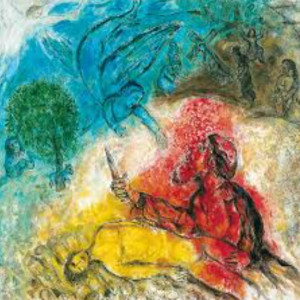
Abraham looks up and sees a ram caught by its horns. The substitution is not a rejection of sacrifice but its redirection. A midrash (a Jewish interpretive story) has Abraham pray, “May it be regarded as if the blood of this ram were the blood of my son Isaac.” The ram dies in Isaac’s place, but Isaac has already died in Abraham’s heart. That is why the angel speaks of the son as not withheld—the offering was complete before the knife struck.
Marc Chagall’s 1966 painting The Sacrifice of Isaac captures what words cannot fully express (Chagall is a Russian Jewish, later French, artist). In Chagall’s vision, the cross is already present at Moriah, hovering as he pictured it somewhere above. As Abraham raises the knife, blood streams down from the cross and the man carrying it to the altar where Isaac is bound. The crimson river pours directly onto the altar where Isaac lies bound. The ram is there too, but the blood tells the truer story: the altar, where Isaac was bound, and the cross above are intricately connected.
A Jewish pharisee, who had met a risen Christ Jesus, whom today we call Apostle Paul, once asked a rhetorical question on behalf of struggling congregations or persecuted early Christ followers in Rome.
He who did not spare His own Son but delivered Him over for us all—how will He not also, with Him, graciously give us all things? (Rom 8:32)
Both Apostle Paul and Marc Chagall understood that just as Abraham was supposed to show God, himself, and others his love for the LORD, so did the LORD have to show his love by offering his only and unique son, Jesus! (John 3:16)
Conclusion
Here is the truth the mountain teaches: God asked Abraham to show his utter and total commitment to Him, and then the LORD showed that He was willing to do exactly the same. Not only could God trust Abraham, but Abraham, as represented by all of his children, can do the same! God did not stop Himself from giving up His beloved Son, Jesus. This is the God that I can trust. And so can you.
Important: You can now help this ministry grow in the way that works best for you. Some give a one-time gift as the Lord leads. Others choose a recurring gift that keeps on giving from month to month. Both types of gifts hold immense significance for us and contribute to our joint cause. Click HERE or below.


My God is the God of Abraham, Isaac and Jacob. He is the triune, God, father son and Holy Spirit.. the word of God tells me that” god is not a man that he should lie neither the son of man, but he should repent that he said shall not do it as he’s spoken and shall not make it”, therefore, I trust him with all things and in all things and I know that what he said he will do he will do make no mistake about it. He is a faithful God and he is faithful in all things. Thank you Dr Eli.
Amen! Blessings!
Before reading your commentary, I hadn’t realised how angry I had been with God for putting Abraham through such a gruelling test. Your explanation that He was showing Abraham the extent of his faith makes good sense and is consistent with the Lord’s kindness. It also occurred to me that Abraham would have been disappointed in himself, because he lied twice about his relationship with Sarah. He had not trusted that God would protect him. Thank you again for opening our eyes to the subtleties of the text.
This was his 10th and final test.
To God be all the glory who gave His only begotten Son so that we are set free who once where captives/ slaves to our sins. Thank you Dr Eli for this beautifully written article to reflect on and be thankful to a graceful and merciful God.
Amen! Thank you, Sylvia for your enocuragement!
Fantastic! The whole scene points to Yeshua, our Redeemer and Savior. HaKadosh Baruch Hu.
Indeed! Blessings and peace!
Father has drawn me into the death of Yeshua and presented me with this resurrected life as my way into living into intimacy in and with Him. It all has been presented in the reality of His deep deep love that draws me into the presence that beckons me to embrace His death and live in His new life. So thankful for His presence here in this present moment.
Amen, my brother! David, thank you for all you do!
Thank you Dr. Eli for this timely reminder of God’s faithfulness and the need of us committing fully to Him. I was wondering what are the other 9 tests, that the Jewish tradition consider to be of the ten events in Abram/Abraham’s time when his faith in YHVH was significantly tested.
Teo, hi. There are different versions of these ten tests. Here is one version. The first: leaving his homeland (Lech Lecha), not knowing the destination. The second: famine in the Promised Land immediately upon arrival—the land of milk and honey offering no bread. The third: the humiliation and rescue of his nephew Lot from the kings of the east. The fourth: hearing God’s promise of an heir while still childless.
The fifth: the expulsion of Ishmael, sending his firstborn son into the wilderness. The sixth: the seemingly endless waiting for Sarah to conceive. The seventh: the ordeal with Pharaoh and Abimelech, twice surrendering Sarah into another man’s household. The eighth: the command to circumcise himself at ninety-nine years old. The ninth: the expulsion of Hagar and Ishmael a second time, this time with divine approval. And the tenth—the greatest and most terrible—the binding of Isaac. Only after those nine lesser fires did God send the furnace of Moriah. Abraham passed the first nine, but the tenth would reveal not merely his obedience but the very nature of faith itself.